
Research & Insights
Precision Rubber Parts for Commercial Trucks: Applications, Benefits and Selection Guide
Commercial trucks operate under demanding conditions where vibration, heavy loads, road shocks, temperature changes, and continuous movement can place significant stress on mechanical and structural components. Precision-engineered rubber components help manage these challenges by providing cushioning, vibration isolation, sealing, flexibility, and protection.
Precision rubber parts for commercial trucks are specially manufactured components designed to meet specific dimensional, performance, and application requirements in heavy-duty vehicles. These parts can be used across suspension systems, engine assemblies, cabins, chassis components, exhaust systems, doors, and other truck applications where controlled flexibility and vibration resistance are required.
For manufacturers, fleet operators, and component suppliers, selecting the right rubber compound, design, hardness, dimensions, and manufacturing process is essential for reliable truck performance.
What Are Precision Rubber Parts for Commercial Trucks?
Precision rubber parts are engineered rubber components manufactured according to defined dimensions and performance specifications. Unlike general-purpose rubber products, these components are designed for particular mechanical applications and may need to withstand compression, vibration, heat, oils, weather exposure, and repeated movement.
Commercial truck applications can include:
-
 Rubber bushes and bushings
-
Engine mounting components
-
Suspension bushes
-
Rubber buffers and bump stops
-
Vibration isolation mounts
-
Sealing components
-
Grommets
-
Rubber pads
-
Dust covers and protective boots
-
Custom-moulded rubber components
-
Chassis and cabin isolation components
The exact design depends on the vehicle system, load conditions, installation environment, and required service life.
Why Are Rubber Components Important in Commercial Trucks?
Heavy commercial vehicles generate considerable vibration and mechanical movement during operation. Rubber components help control these forces and provide separation between components that may otherwise experience excessive impact or friction.
A properly engineered rubber component can help:
-
Reduce vibration: Rubber absorbs and
isolates vibration generated by engines, drivetrains,
suspension systems, and road surfaces.
-
Control noise: Rubber isolation components
can reduce the transmission of mechanical noise through
vehicle structures.
-
Absorb shocks: Rubber buffers and similar
components can cushion impacts caused by road conditions and
component movement.
-
Protect components: Rubber parts can
prevent direct contact between metal components, reducing
wear and impact.
-
Provide sealing: Specialised rubber seals
and grommets can help prevent the entry of water, dust, and
other contaminants.
-
Accommodate movement: : Flexible rubber
components can allow controlled movement between connected
parts while maintaining structural integrity.
Common Applications of Precision Rubber Parts in Trucks
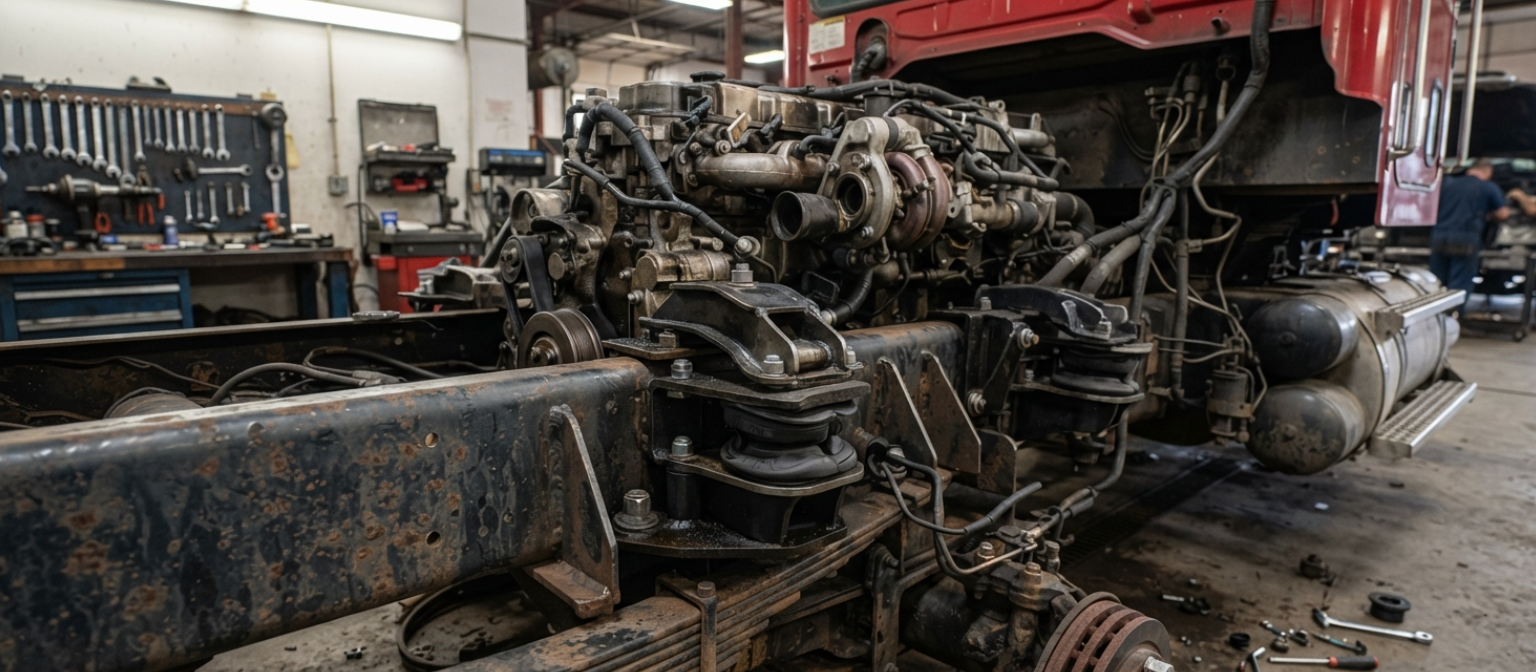
1. Engine Mounting Systems
Engine mounts help secure the engine while managing vibration generated by the powertrain. Rubber elements within mounting systems can provide controlled isolation between the engine and vehicle chassis.
The correct rubber compound and mount design are important because the component must support the required load while maintaining appropriate vibration characteristics.
2. Suspension Systems
Commercial truck suspension systems experience continuous loading and movement. Rubber bushes and related components can help provide controlled flexibility between suspension components.
They are commonly designed to accommodate movement while helping reduce vibration and shock transfer.
3. Cabin Mounting
Cabin mounts can help isolate the driver's cabin from chassis vibration. Properly engineered rubber mounting components can contribute to improved ride comfort and reduced vibration transmission.
This is particularly relevant to trucks that operate for extended periods and across varied road conditions.
4. Chassis and Structural Applications
Rubber pads, buffers, bushes, and isolators can be incorporated into chassis-related assemblies. These components can help minimise metal-to-metal contact and manage movement between connected structures.
5. Exhaust and Heat-Exposed Applications
Some commercial truck rubber components operate near heat-generating systems. In these applications, the rubber compound must be selected according to the expected temperature and environmental exposure.
Heat-resistant rubber formulations may be required where conventional compounds would not provide adequate performance.
6. Sealing and Protection
Rubber grommets, seals, boots, and protective components can help shield mechanical or electrical interfaces from dust, moisture, vibration, and environmental contamination.
What Materials Are Used for Commercial Truck Rubber Parts?
The appropriate rubber material depends on the operating environment and performance requirements.
Common elastomer choices may include:
-
Natural Rubber (NR): Often used where elasticity, resilience, and dynamic performance are important.
-
EPDM: Suitable for applications requiring resistance to weathering, ozone, water, and temperature variations.
-
Nitrile Rubber (NBR): Commonly considered where resistance to petroleum-based oils and fuels is required.
-
Neoprene (CR): Offers a balance of weather, ozone, and oil resistance for selected applications.
-
Silicone: Used in applications requiring broad temperature resistance and specific sealing or flexibility characteristics.
-
Other engineered elastomers: Selected according to application-specific temperature, chemical, compression, durability, and mechanical requirements.
Material selection should be based on actual operating conditions rather than choosing a compound solely by its general-purpose characteristics.
Key Factors When Selecting Precision Rubber Truck Components
Choosing a suitable rubber component involves more than matching its physical dimensions. Manufacturers and buyers should consider several technical factors.
Load Requirements
The component must be capable of handling the expected static and dynamic loads without excessive deformation or premature failure.
Hardness
Rubber hardness influences stiffness, compression behaviour, vibration isolation, and overall component performance. The appropriate hardness depends on the application.
Temperature
Operating temperature should be considered when selecting the elastomer. Components exposed to engine heat, exhaust systems, or extreme environmental temperatures may require specialised materials.
Chemical Exposure
Contact with engine oil, transmission fluids, fuels, cleaning chemicals, or other substances can affect certain rubber compounds. Chemical compatibility should therefore be evaluated during material selection.
Compression and Dynamic Performance
Some truck components experience repeated compression, flexing, or shear. Dynamic fatigue characteristics can be important for applications involving continuous movement.
Environmental Exposure
Outdoor commercial vehicles may experience sunlight, rain, humidity, dust, mud, ozone, and changing temperatures. The rubber formulation should suit these conditions.
Dimensional Accuracy
Precision applications require controlled dimensions and consistent manufacturing tolerances. Accurate dimensions help ensure proper fit, alignment, and assembly performance.
Benefits of Precision-Engineered Rubber Components
Precision-manufactured rubber components can provide several functional benefits for commercial vehicle applications.
Improved Vibration Isolation
Engineered rubber mounts and isolators can help reduce vibration transmission between assemblies.
Controlled Component Movement
Rubber bushes can allow movement within defined limits while maintaining connection between components.
Reduced Mechanical Stress
By cushioning impacts and isolating vibration, rubber components can help reduce stress transferred to surrounding assemblies.
Better Environmental Protection
Seals, boots, and grommets can help protect components from dust, moisture, and other contaminants.
Application-Specific Performance
Custom rubber components can be developed around specific dimensions, load conditions, materials, and operating environments.
How Are Precision Rubber Parts Manufactured?
Manufacturing methods vary according to the component design, material, production volume, and required specifications.
Compression moulding, transfer moulding, and injection moulding are among the processes used for rubber component manufacturing. Some applications may also require secondary operations such as trimming, bonding, finishing, or assembly with metal inserts.
Quality control can include dimensional inspection, hardness testing, visual inspection, material verification, and application-specific performance testing.
For commercial truck components, consistency between production batches is particularly important because variations in dimensions or material properties can affect assembly and performance.
Why Choose an Experienced Rubber Component Manufacturer?
Commercial vehicle rubber components can have application-specific requirements that differ considerably from standard industrial rubber products. An experienced manufacturer can assess factors such as load, temperature, chemical exposure, hardness, geometry, movement, and environmental conditions before recommending an appropriate solution.
At Elasto Mount, precision rubber components can be developed for demanding automotive and commercial vehicle applications, with attention to material selection, component design, dimensional requirements, and manufacturing consistency.
For truck manufacturers, automotive component suppliers, and industrial buyers, working with a technically capable rubber component manufacturer can support the development of parts suited to specific vehicle requirements.
Frequently Asked Questions
What are precision rubber parts for commercial trucks?
Precision rubber parts for commercial trucks are engineered elastomer components manufactured to specific dimensional and performance requirements for applications such as engine mounting, suspension, cabin mounting, chassis isolation, sealing, and vibration control.
Which rubber is commonly used for truck components?
The appropriate material depends on the application. Natural rubber, EPDM, NBR, neoprene, silicone, and other engineered elastomers may be considered based on temperature, chemical exposure, flexibility, load, and environmental requirements.
Why are rubber mounts used in commercial trucks?
Rubber mounts can help isolate vibration, absorb shocks, control movement, reduce noise transmission, and protect connected components from excessive mechanical stress.
Can rubber components be custom manufactured for commercial trucks?
Yes. Custom rubber components can be manufactured according to specific drawings, dimensions, hardness requirements, material specifications, operating conditions, and assembly requirements.
How do I select the right rubber component for a truck application?
Consider the component's dimensions, load, movement, hardness, temperature range, chemical exposure, environmental conditions, and expected service requirements. A technical assessment can help determine the appropriate material and design.
What quality factors matter in precision rubber parts?
Dimensional accuracy, material consistency, hardness, surface quality, moulding quality, bonding where applicable, and application-specific performance are important considerations for precision rubber components.
Where are precision rubber components used in commercial vehicles?
They can be used in engine mounts, suspension systems, cabin mounts, chassis assemblies, exhaust-related applications, sealing systems, vibration isolators, buffers, grommets, and other vehicle assemblies.